
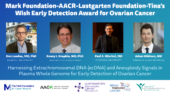
2026-2027 Team Science Grantees: Dan A. Landau, MD, PhD; Paul Mischel, MD; Adam Widman, MD; Ronny Drapkin, MD, PhD
About Project
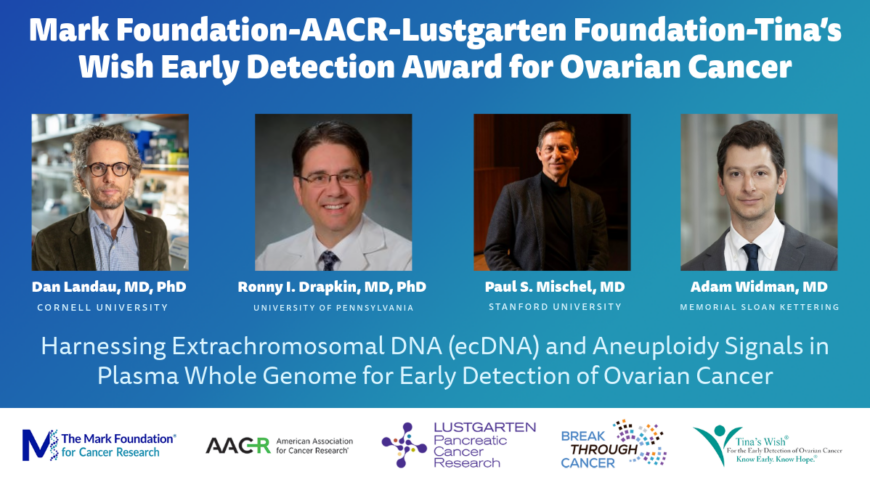
Mark Foundation-AACR-Lustgarten Foundation-Tina’s Wish Early Detection Award for Ovarian Cancer
Tina’s Wish is proud to join forces with a new coalition of leading nonprofit organizations — including American Association for Cancer Research (AACR), Break Through Cancer, Lustgarten Foundation, and The Mark Foundation for Cancer Research. We all share one main goal: to solve the critical challenge of early detection and diagnosis for some of the world’s complex cancers. Together, we will fund $12 million across six groundbreaking teams of researchers focused on early detection in their respective areas of expertise — including ovarian, pancreatic, and esophageal cancers. Funding from Tina’s Wish is specifically designated to support the “Innovative Liquid Biopsy Solutions for Ovarian Cancer Early Detection” project, described below.
Read the full Press Release
Innovative liquid biopsy solutions for ovarian cancer early detection
Project Summary
Smaller tumors are easier to eradicate than larger tumors, so the earlier that we can detect cancer, the better we are at effectively treating it. However, early cancer detection is inherently challenging, as signals that indicate malignancy may be too sparse to identify using current assays. This problem of early detection is particularly acute for ovarian cancer, which is commonly diagnosed at later stages and has a five-year survival rate of only 30%. Available ovarian cancer screening approaches have not been successful in reducing mortality, highlighting an urgent need for new methods. Here, we address this challenge through developing novel frameworks for characterizing ovarian cancer at the earliest stages and harnessing this information to build non-invasive assays that detect evidence of pre-cancerous or cancerous cells in the blood. We hypothesis that specific genetic signals define normal, pre-cancer and cancer cells, and that these signals can be used to detect early-stage cancer through liquid biopsy. We will first use advanced single-cell genomics technology to create genetic profiles for normal, pre-cancer and cancer cells. We will then develop highly sensitive assays to detect these genetic signals from blood, establishing the earliest timepoint that ovarian cancer or precursors genetic markers can be observed in order to inform the design of screening tests for larger patient cohorts. Together, this work will lay the foundation for highly accurate ovarian cancer screening strategies that will enable earlier detection, allowing for the deployment of more effective treatments that will ultimately lead to improved patient outcomes.